
Technical SEO — the master record
Rankings are downstream of architecture.
Most SEO reports describe activity. This page documents outcomes: the same law firm, the same market, the same content team—before and after the platform underneath was rebuilt. Every screenshot below is a real, dated system output from the JTNY Law proving environment.
Site performance, measured globally
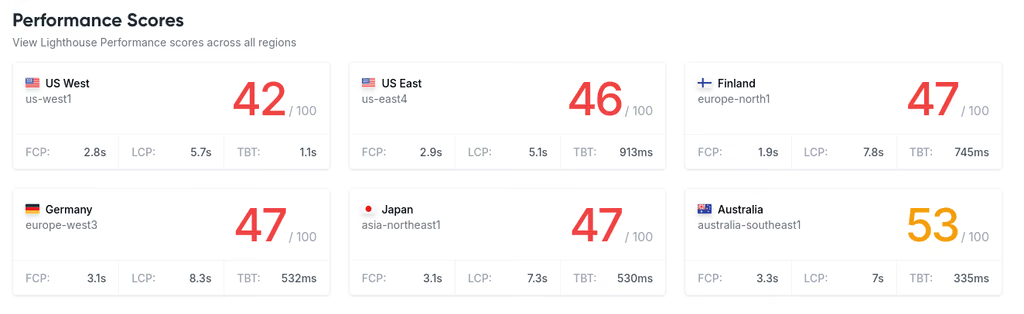
- source
- Lighthouse
- property
- jtnylaw.com — legacy WordPress build
- window
- 2025; exact capture date unverified
- unit
- performance score /100, per region × 6 regions
- definition
- Lighthouse Performance category score; LCP shown per region
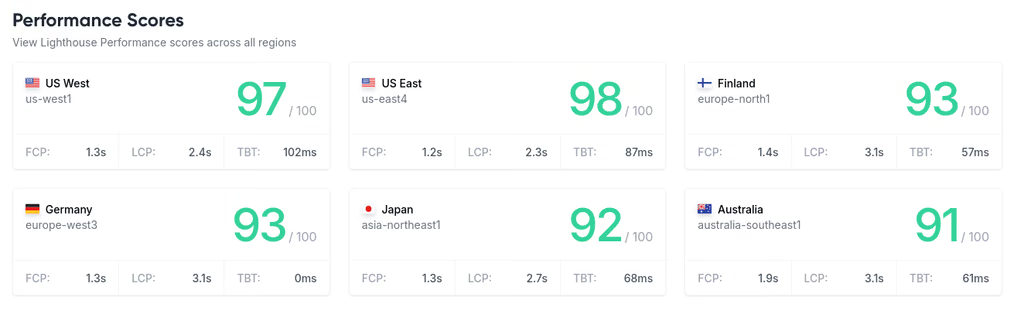
- source
- Lighthouse
- property
- jtnylaw.com — after rebuild
- window
- 2025; exact capture date unverified
- unit
- performance score /100, per region × 6 regions
- definition
- Lighthouse Performance category score; LCP shown per region
Same firm, same six test regions. The legacy WordPress build scored 42–53 with Largest Contentful Paint between 5 and 8 seconds. The rebuilt static-first architecture scores 91–98 with LCP between 2.3 and 3.1 seconds—before any content changed.
Organic keyword footprint
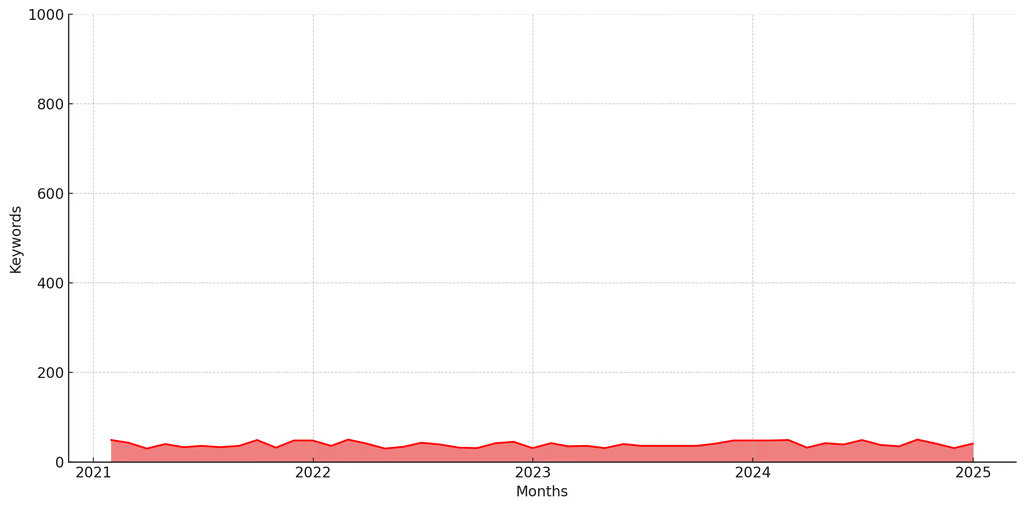
- source
- archived keyword chart; original tracking tool unverified
- property
- jtnylaw.com — legacy platform
- window
- 2021 → early 2025
- unit
- ranking keywords, count
- definition
- ranking keyword count; position threshold unverified
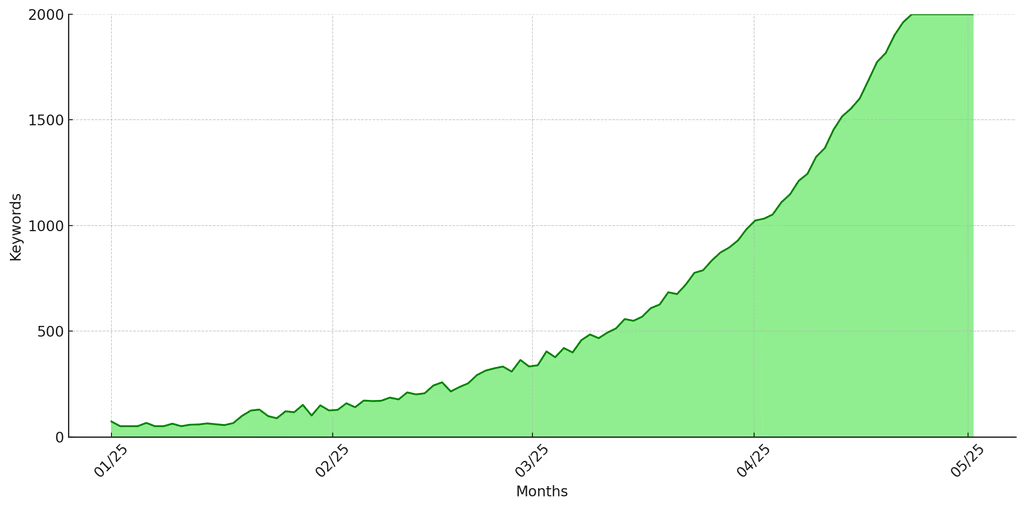
- source
- archived keyword chart; original tracking tool unverified
- property
- jtnylaw.com — after rebuild
- window
- Jan → May 2025
- unit
- ranking keywords, count
- definition
- ranking keyword count; position threshold unverified
The archived charts show roughly 40–60 ranking keywords in the earlier series and more than 2,000 in the later series. The original tracking tool and position threshold are unverified, so these charts are historical context, not an audited growth estimate or an isolated effect of the rebuild.
Engagement, not just traffic
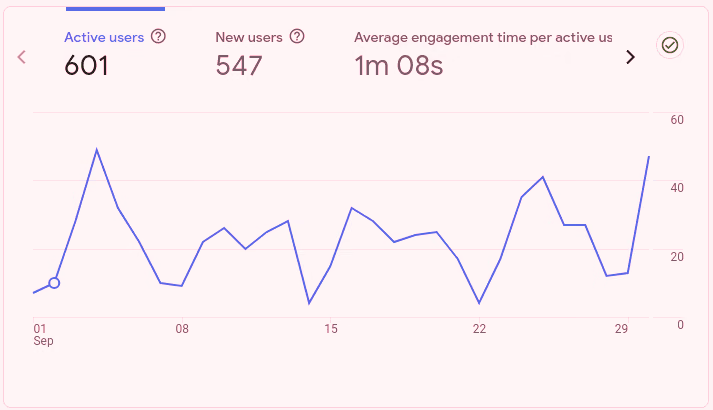
- source
- GA4
- property
- jtnylaw.com — legacy platform
- window
- 1 → 30 Sep; year unverified
- unit
- active users, count; engagement time = average per active user
- definition
- GA4 “Active users” and “Average engagement time per active user”; audience segment and bot exclusions unverified
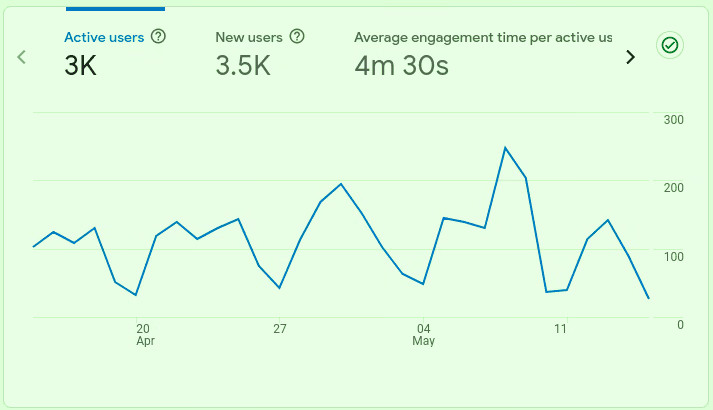
- source
- GA4
- property
- jtnylaw.com — after rebuild
- window
- mid-Apr → mid-May 2025, one month
- unit
- active users, count; engagement time = average per active user
- definition
- GA4 “Active users” and “Average engagement time per active user”; audience segment and bot exclusions unverified
The archived GA4 panels display 601 and 3,000 active users, with average engagement times of 1m 08s and 4m 30s. The earlier year, audience segments and bot exclusions are unverified. These panels do not establish a comparable growth rate, additional inquiries or retained matters.
Source: JTNY Law (jtnylaw.com) proving environment. Lighthouse via multi-region testing; keywords via rank tracking charts; engagement panels labeled GA4. Missing source metadata is identified under each exhibit. These archived comparisons do not establish causation or a current, bot-adjusted growth rate.
Why this matters for law firms
Legal search is judged by a stricter standard.
Google classifies legal content as YMYL—"Your Money or Your Life"—and evaluates it with elevated scrutiny on expertise, authority, and trust. A technically weak site undermines every content dollar spent on top of it: slow templates suppress rankings, broken structure hides pages from crawlers, and missing schema keeps the firm out of AI-generated answers.
The economics amplify the stakes. Legal clicks are among the most expensive in paid search—high-intent queries routinely exceed $100 per click. Every organic position a firm loses to a technically superior competitor is a position it must rent back from Google at those rates.
That is why Wolfe treats technical SEO as infrastructure—engineered once, enforced continuously, owned by the firm.
The discipline
What technical SEO covers inside the Legal Growth OS.
Rendering architecture & Core Web Vitals
Static-first rendering on edge infrastructure. LCP, INP, and CLS engineered at the template level—not patched with plugins after the fact. Performance budgets are enforced per deploy, not audited once a year.
Crawlability & information architecture
Clean URL hierarchies, canonical discipline, sitemap governance, and redirect maps maintained as code. Every published URL either resolves or 301s—no orphaned pages, no soft 404s silently leaking crawl budget.
Structured data as a system
Organization, LegalService, Article, FAQ, and Breadcrumb schema generated from templates, validated in CI. Structured data is how search engines and AI answer engines parse who you are and what you handle.
Corpus governance
One page per intent. Cannibalization detection, thin-content pruning, and refresh cadence rules so a growing content library compounds instead of competing with itself.
Internal link engineering
Authority routed deliberately from high-equity pages to money pages. Link placement is mapped and versioned, not left to whoever wrote the last post.
Measurement & regression control
First-party analytics, Search Console monitoring, and scheduled Lighthouse runs across regions. Regressions are caught by instrumentation—not discovered in next quarter’s report.
six disciplines · enforced per deploy, not audited per quarter
The standard
What every Wolfe build is held to.
These are enforced budgets verified on every deployment—not aspirations audited annually.
- Lighthouse performance
- ≥ 90 in every test region, verified on every deploy
- Largest Contentful Paint
- < 2.5s at the 75th percentile
- Rendering
- Static-first; no render-blocking third-party scripts
- Structured data
- Valid schema on every template, linted in CI
- URL integrity
- Zero orphan pages; every retired URL 301s
- Analytics
- First-party collection; ad-blocker-resilient measurement
Questions
Asked by managing partners, answered plainly.
Q01
Why does site speed matter for a law firm specifically?
Legal queries fall under Google’s YMYL (Your Money or Your Life) classification, which applies stricter quality evaluation. Core Web Vitals are a confirmed ranking input, and legal clicks are among the most expensive in paid search—so organic positions lost to a slow site are disproportionately costly to buy back.
Q02
Can technical SEO be fixed on an existing WordPress site?
Sometimes, partially. Caching layers and plugin audits can move a Lighthouse score from the 40s into the 60s. The ceiling is the architecture itself: page builders, plugin chains, and third-party scripts set a floor on load time that no amount of tuning removes. That is why the record above shows a rebuild, not a tune-up.
Q03
How long until technical work shows in rankings?
Performance improvements are measurable immediately and re-crawled within weeks. The archived keyword chart covers five months, but its source and counting threshold remain unverified. It does not establish a delivery timetable for another firm.
Q04
Is this included in both Wolfe products?
Yes. The Growth Platform and the Legal Growth OS are built on the same technical architecture and held to the same standards. Engagements begin at $20,000/month.
Get your firm's technical record measured.
The Architecture Review includes the same multi-region performance testing, crawl analysis, and structural audit shown on this page—run against your current site and vendor stack.
Request an Architecture Review