
For law firms spending $100,000+ a month on ads
Stop renting your leads.
You are spending six figures a month on ads and still not getting the intakes you want. Give us a fraction of that budget. We build the search traffic your firm owns, and wire every inquiry into an intake system that answers in business hours, not business days.
Built on owned Astro and Cloudflare infrastructure. Integrated with Docket. Running today at a working New York firm. Engagements begin at $20,000/month.
Can your SEO company do this?
The arithmetic
Your ad budget, by the numbers.
Paid search rents attention by the click. The month the budget pauses, the phone goes quiet, and everything you spent last year buys nothing this year. Owned search is the opposite kind of asset: pages that keep working after the invoice is paid.
Move the slider to your firm’s monthly ad spend.
- Annual ad spend at that rate
- $1,200,000
- What the firm keeps when the budget stops
- Nothing. The traffic stops with the invoice.
- Engagements begin at $20,000/month.
- of that monthly ad budget
a fraction of the budget · an asset the firm keeps
Apply for an Architecture ReviewRented vs. owned
Every ad dollar rents a click. Every page we build, you keep.
Rented
Ad spend
- Every click is billed. The auction resets on the first of the month.
- Cost per click rises whenever a competitor decides to outbid you.
- The vendor owns the account, the data, and the reporting.
- The day the budget pauses, the phone goes quiet.
Owned
Organic search
- Every page is an asset on the firm’s own domain, in the firm’s own repository.
- Search visibility compounds as the corpus grows and ages.
- The firm owns the code, the content, the records, and the accounts.
- The pages keep working after the invoice is paid.
paid and organic are not enemies · the objective is a budget that builds something · why the normal agency model is incomplete →

Flammarion, 1888 · past the edge of the known sky · build for where search is going
What a fraction of the budget builds
Three layers. One system. Owned by the firm.
Traffic alone is not the product. The product is the connected path from the search to the signed matter, and the firm’s ability to see it.
01
Search traffic the firm owns.
A governed content system on a fast, owned Astro/Cloudflare platform: technical architecture, topic ownership, cannibalization controls, structured data, and an editorial operating cadence. The demand layer that does not stop when a budget does.
How we build law firm SEO02
A website that turns a visit into a decision.
Conversion paths built around the visitor’s legal situation, not a generic contact page. Every call and form carries its source, landing page, campaign, and session, so attribution is captured at the lead instead of reconstructed later.
How we build the platform03
An intake system that answers.
Docket receives the whole record within a minute, triaged and attributed. First contact is measured in business hours. A missed call becomes a lead. Repeat contacts merge into one person instead of three intakes.
Inside DocketAlready on the record
Measured on a real firm. Same market, before and after.
The proving environment is a working New York firm. The technical record is published with source details and measurement limits. Nothing here is a projection.
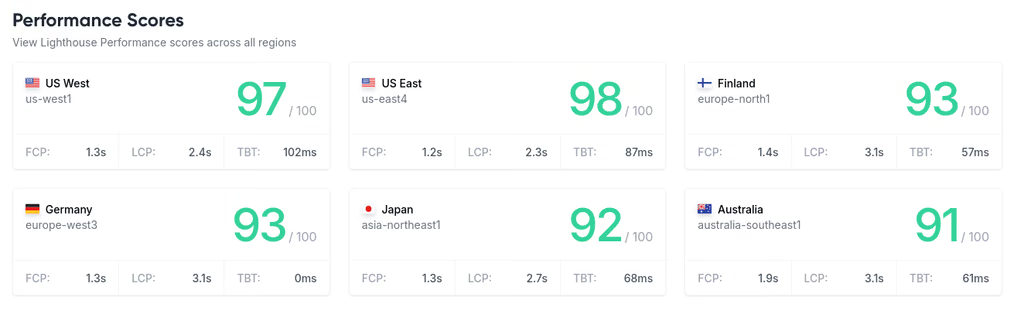
Lighthouse performance, six global regions
42–53 91–98
Same site, before and after the platform rebuild. Captured 2025.
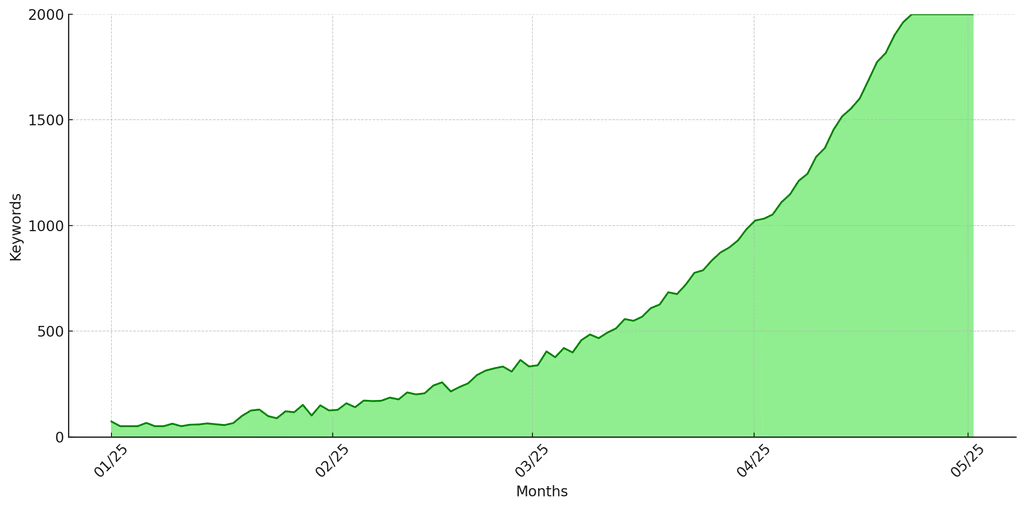
Ranking keywords
~60 2,000+
Five months on the governed content system, Jan → May 2025.
Avg. engagement per active user
1m 08s 4m 30s
GA4, measured on first-party analytics, 2025.
Core Web Vitals, real users
Passed
Lighthouse 100 / 100 / 100 / 100. PageSpeed Insights, Chrome UX Report, 28-day window, Sep 2, 2026.
Every exhibit carries its source, window, and capture date. The full technical record → The case study →
Watch a lead move through the system
Most firms run five disconnected tools. One New York firm built the gaps out.
A website vendor. A form plugin that emails a shared inbox. A call-tracking vendor. A CRM or spreadsheet someone re-keys leads into. A practice-management system that only sees the ones that survive. Leads go cold in the gaps between them.
A personal injury and employment firm on Long Island runs one connected pipeline from web visitor to opened matter. Everything below is live as of September 2026.
-
01
The website captures the whole journey, not just the form.
Every submission records the first page the visitor ever landed on, the referrer, the campaign parameters, the article or practice page they converted from, the button they used, and how many pages they read first. Attribution is tied to the lead, not guessed later.
-
02
Bots and spam never reach a human.
A hidden honeypot, a fail-closed challenge, and a ten-minute duplicate filter drop the junk before it costs anyone a minute. Vendor pitches and SEO spam are flagged automatically as “not a client inquiry.”
-
03
Every inquiry is triaged twice, within seconds.
A rules engine flags urgency: fatality language, hospitalization, hit-and-run, statute-of-limitations risk, municipal notice-of-claim windows. Then an AI review reads the narrative and writes an internal case-viability score from 1 to 10, the reasons, red flags, the questions to ask on the callback, and names for a conflict check. If the core facts are missing, it says so and lists what to ask instead of guessing. It orders the queue. An attorney makes every decision.
-
04
The intake team sees it where they already work.
The lead alert lands in Slack and by SMS with the triage banner, and the AI review posts as a thread reply beneath it. Critical after-hours leads can be routed to a live answering service.
-
05
Docket receives the whole record.
Not name, phone, and message. The full attribution, the qualifiers such as incident date and prior representation, the triage tier and its reasons, and off-hours status. Repeat contacts are merged by phone number across web, phone, and email so one person never becomes three intakes. An events ledger keeps every touch for reporting.
-
06
Phones live in the same system.
Four tracking numbers swap in by page type. Calls log to the same database as the forms. A missed call becomes a lead automatically.
-
07
Reporting closes the loop.
Qualified and retained rates by traffic source, by content cluster, and by triage tier. The firm learns which articles and campaigns produce cases, not just clicks.
Docket · the intake layer
From the form to the intake inbox, with the source attached.
The moment someone reaches out, the lead is written to a permanent record and delivered into Docket’s live intake inbox: the raw lead in under a second, the full triaged record with its attribution and AI review within a minute of submission. No email forwarding, no morning copy-paste, no lead sitting in a form-tool dashboard overnight.
-
01
The website
Someone reaches out — a form or a call on the AstroPress site.
-
02
The record
Cloudflare writes the lead first. One record per lead — no duplicates.
-
03
Docket inbox
The lead appears in live intake, attributed to the source that sent it.
The happy path lands in under a second. A 30-second poller and a 5-minute reconciliation sweep make sure no lead is ever lost.
- triage + ai review
- about 15 seconds after submission
- docket hand-off
- within a minute
- duplicates
- merged by phone across web · phone · email
- decisions
- an attorney, every time
the closed outcome loop, where case results reshape content decisions automatically, is roadmap · today outcomes return through the operating review · shipped vs. roadmap →
This is for
Firms with real acquisition economics.
- Firms spending $100,000 or more a month on paid acquisition
- Multi-attorney consumer practices: personal injury, criminal defense, family, bankruptcy, employment
- Leadership that can see the intake data and is willing to change the process
- Firms that want to own the platform, the content, and the records
This is not for
Firms that want a cheaper version of what they have.
- Solo practices looking for a brochure site
- Firms shopping for a low-cost SEO retainer
- Firms that want guaranteed rankings or instant lead volume
- Firms that will not share intake data or change a broken workflow
If that is your firm today, we will say so respectfully rather than pull you into an enterprise sales process.
What we will never say
Four things you will not read on this page.
01
That the AI decides which cases you take, or contacts a client.
It does neither. It orders the queue and writes the questions; an attorney decides and a person calls.
02
A conversion rate or lead count we cannot hand you with a source.
Every number we publish carries a date range, a denominator, and a definition. If it does not, we do not publish it.
03
Guaranteed rankings, case counts, or revenue.
Nobody honest can. What we can do is show you the system, the record, and the firm it runs in.
04
“AI-powered.”
This audience distrusts the phrase, and so do we. The credibility is in the mechanics, so we show you the mechanics.
How it starts
The Architecture Review comes before the engagement.
A paid, fixed-fee diagnostic of your entire growth system. It produces the blueprint a serious engagement is built on, and the review stands on its own: even if we never work together, your firm keeps the constraint analysis, the data-flow map, and the roadmap.
Apply for an Architecture Review-
stage 01
Apply
Under a minute, below. Every application is read personally.
-
stage 02
Fit call
Firms with credible budget, operational need, and authority are routed to a short review call.
-
stage 03
The review
Current-state interviews and access, a map of your ad spend, website, vendors, attribution, and intake path, over 2–3 weeks.
-
stage 04
Findings and blueprint
Three to five structural constraints, a future-state architecture, and a phased roadmap, presented privately to your leadership.


Application
Keep the cases. Cut the rent.
The application takes under a minute. It exists to make sure the review is worth your leadership’s time, and ours. Every application is read personally, and we reply within two business days.
Privacy: your application is transmitted securely and used solely to evaluate fit and prepare the Architecture Review. We capture the page, source, and campaign that brought you here as first-party attribution data. We do not sell or share application data, and we do not add you to a mailing list without consent.